My agents keep coding while I’m at the gym
A rented server, a Telegram bot and a voice note. My coding agents keep working on my projects while my laptop stays closed in my bag.
I know I’m not the first one building this, but personally it felt like a relief and a huge progress on my personal projects. So here’s how it works, why I built it, and the part I still haven’t figured out.
Babysitting a laptop
Before, I had to keep my laptop on at night so the agent kept running. And during the day I was stuck in front of the screen pressing “Accept”, “Yes”, “Continue”, when the only moment I actually needed to be there was when it was time to review the implementations.
My resources were being completely drained. With several agents running in parallel I had to charge the laptop every two and a half hours.
And my quota and rate limits weren’t being properly squeezed. I already pay for Claude and ChatGPT, and every hour the laptop was closed was quota I paid for and didn’t use.
Why not just leave it on, or buy a Mac mini?
Leaving the laptop on doesn’t fix anything. I’d still have to stare at it the whole day, and it would destroy the battery.
A Mac mini at home would work, but one with enough RAM to run several agents costs well over a thousand euros. A rented server costs me less than 20 euros a month.
So I set up a server
It’s a rented machine, always on. Three things live on it:
- Orca, where my coding agents work.
- OpenClaw, the assistant I talk to on Telegram. It receives my messages and decides what to do with my orders.
- whisper.cpp, which turns my voice notes into text on the server itself. It’s free, and the audio never leaves the machine.
The server isn’t open to the internet at all. Only my own devices can reach it, through a private network (Tailscale).

What it actually does
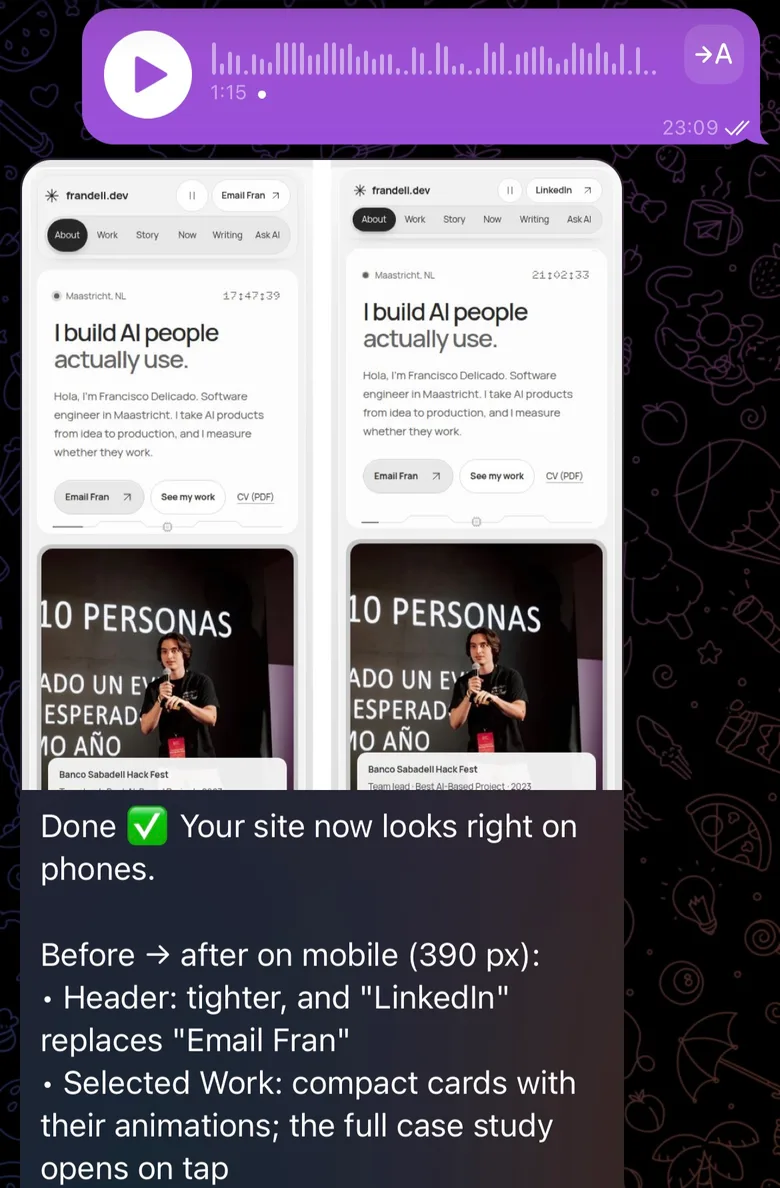
I send a voice message, OpenClaw receives it and that’s it, it starts working on my server. Previews, images, reports, audits, checks, whatever I ask for, it can do as if it was me with my laptop and my projects.
Under the hood, the voice note is transcribed (23 seconds of audio takes about 13), OpenClaw opens a fresh copy of the project in Orca and launches an agent, usually Claude Sonnet or Opus, to do the work. Then a different model, GPT, reviews it, so the model that wrote the code isn’t the one checking it. When it’s done I get a private preview I can open on my phone, with before and after screenshots, right in Telegram.
My laptop isn’t part of any of this. It can be closed in my bag.
In the first 44 hours: 48 agent sessions across 4 of my projects, and 10 of them were reviews by a different model than the one that wrote the code.
How much freedom should an agent have?
This is the part I haven’t solved.
I know when you build something with this amount of freedom you need to be careful with the amount of freedom or access they have. Even though I have quite a good harness, they still fuck it up quite easily.
What I have today: the server is invisible from the internet, every agent works in its own copy of the project, and a second model reviews the work. But inside the server, an agent can still reach a lot of my stuff.
So that’s something I’m currently working on: to what extent the agent should be completely free within my data in the server, even though it is a “sandbox”.
So far
It’s kinda crazy, honestly. The agents keep working while I’m out, and I only sit down when there’s something to review, which was the whole point.
If you’re building something similar, or you’ve figured out the freedom problem better than me, tell me.